
Thanks For The Visit !


Farmboyzim's Freeware Finds
deHavilland Mk III Turbo Beaver
Review by Farmboyzim
deHavilland Mk III Turbo Beaver
Review by Farmboyzim

I'll start out by saying that anything made by DeHavilland, I'm going to like! The same goes for anything made by the team over at Premier Aircraft Design (PAD). The crew at PAD is comprised of Jean-Pierre Brisard, Barry Blaisdell, Bob May and Kevin Pardy, names that may sound familiar to you if you've been simming around for awhile. These guys are multiple winners of freeware awards for their renditions of various aircraft, old and new, large and small. Their model of the DeHavilland Mk III Turbo Beaver is both the topic of review and will also be used in the upcoming February Hop Race, so we'll cover this aircraft in a bit more depth, to give you a good heads-up on what she's all about!
The DeHavilland name is synonymous with bush flying. They have been making stout, nimble, and versatile aircraft for quite some time, with the "Beaver" line dating back to the late 40's. To this day, you'll find these aircraft shuttling supplies, cargo, and people into and out of remote, unimproved airstrips.
The DeHavilland name is synonymous with bush flying. They have been making stout, nimble, and versatile aircraft for quite some time, with the "Beaver" line dating back to the late 40's. To this day, you'll find these aircraft shuttling supplies, cargo, and people into and out of remote, unimproved airstrips.


www.farmboyzimsflightsims.com
FBZFS

Home
Product Reviews
Freeware Reviews
Press Releases
Forum
Articles
Screenshot Gallery
Downloads
Multiplayer Server
TeamSpeak
Tutorials
General Store
Aircraft of the World
Weather
Maps
Links
Certificates
Product Reviews
Freeware Reviews
Press Releases
Forum
Articles
Screenshot Gallery
Downloads
Multiplayer Server
TeamSpeak
Tutorials
General Store
Aircraft of the World
Weather
Maps
Links
Certificates
Here's the description of the package from the original zip files...
FS2004 DeHavilland DHC2-MK3 Turbo Beaver on Tundra Tires. Merric Aviation N7620, circa 1974. Designed in FSDS2 & FSDS3 with full animation, wing views, dynamic shine, full suspension, Water Rudders. Includes a pair of 2D Panels and a dynamic VC with a complete cabin, with opening crew doors and Passenger doors, custom sound, Check & Ref HTML files and more. Panel help can be found in the Panel_Docs folder and in the Kneepad. By Jean-Pierre Brisard, Barry Blaisdell, Bob May, and Kevin Pardy - Premier Aircraft Design.
FS2004 DeHavilland DHC2-MK3 Turbo Beaver on Tundra Tires. Merric Aviation N7620, circa 1974. Designed in FSDS2 & FSDS3 with full animation, wing views, dynamic shine, full suspension, Water Rudders. Includes a pair of 2D Panels and a dynamic VC with a complete cabin, with opening crew doors and Passenger doors, custom sound, Check & Ref HTML files and more. Panel help can be found in the Panel_Docs folder and in the Kneepad. By Jean-Pierre Brisard, Barry Blaisdell, Bob May, and Kevin Pardy - Premier Aircraft Design.

The Mk III Turbo Beaver has a turbine engine, can carry more passengers, climb and cruise faster, and also has a higher service ceiling than the standard Beaver, from which the Mk III evolved from. The nose of the Turbo is tapered, where the standard Beaver has more of a blunt nose. The engine of the Mk III is also much lighter, hundreds of pounds in fact, which accounts for the larger tail. The standard DHC-2 Beaver was

introduced to the aviation world back in 1947, and when production ceased in 1967, around 1600 aircraft were built. Before the end of production, the Beaver was the first single-engine aircraft to be turbine powered, with over 60 Turbo Mk III's being produced.
Powered with a Pratt & Whitney (P&W) PT6A-20, some of the Mk III's have been outfitted with the P&W PT6A-27 by the Viking Aircraft Corporation, who became the sole manufacturer and distributor of deHavilland parts. Viking aquired the jigs and drawings for the aircraft form deHavilland Canada. As stated on the Viking site, with the improved engine, the "all-up" weight of the aircraft has been increased to 6,000 pounds, enabling a cargo of 2,450 pounds to be carried.
The Mk III can operate out of unsurfaced airstrips and even forest clearings, as long as there is at least 1,000 feet of strip available. I've gotten the aircraft model off the ground in less than that, with the landings usually taking up a good portion of that distance.
Powered with a Pratt & Whitney (P&W) PT6A-20, some of the Mk III's have been outfitted with the P&W PT6A-27 by the Viking Aircraft Corporation, who became the sole manufacturer and distributor of deHavilland parts. Viking aquired the jigs and drawings for the aircraft form deHavilland Canada. As stated on the Viking site, with the improved engine, the "all-up" weight of the aircraft has been increased to 6,000 pounds, enabling a cargo of 2,450 pounds to be carried.
The Mk III can operate out of unsurfaced airstrips and even forest clearings, as long as there is at least 1,000 feet of strip available. I've gotten the aircraft model off the ground in less than that, with the landings usually taking up a good portion of that distance.


The "real" Mk III can be utilized and configured in various ways to suit the particular needs of it's tasking, such as a cabin extension, accommodating more windows for passengers, along with a cargo door and cargo netting. Other variations in the Mk III are floats/amphibious gear, or skis. It has been adapted to fulfill the roles in agriculture by being fitted to spray, dust, or seed. Many other industries utilize this aircraft simply because of its sturdiness and dependability.


deHavilland Mk III Turbo Beaver
deHavilland DHC-2 Beaver

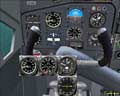
The team over at PAD has done their usual award winning work in modeling this great aircraft. It is easily seen why they have received so many Freeware Awards. The amount of detail in the exterior modeling is fantastic, and could even rival some of the payware models that are out there. The modeling of the aircraft itself is very realistic and detailed, smoothly rendered, great textures all the way around (aircraft, prop, paint, etc.), and fantastic paint jobs! The float version of the Turbo is absolutely awesome, and truly is quite the piece of artwork! Working flight control surfaces doors and hatches all work smoothly. Stepping inside of this wonderful aircraft, we find the typical DeHavilland panel configuration. You'll
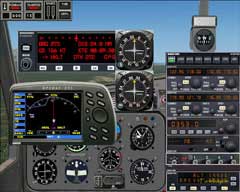
find the DeHavilland panels are very pilot-friendly, and easy to understand. The only major difference between the cockpits of these models is the yoke configuration. One of the models is set up with a yoke that can be "flipped" over to the copilot’s position, while the other configuration is that of the more conventional two-yoke configuration. All gauges and pop up panels are clear and can be easily read. Some of the gauges are enlarged for viewing by clicking on them. To access the lights, fuel, and other information, you need to go to the IFR panel (see pic below). To do this you must click on the simicon that has the two arrows. More simicons are used to access the following... DME gauge, VOR gauge, and a Taxi/Pushback gauge (made by Rob Barendregt) which comes with a how-to readme file and are easy to use. Quick note here...be sure to read the instructions on the Taxi/Pushback gauge. You still need to use Shift + P for example, to get everything moving for your pushback, but the gauge is where the brains are, dictating how far, how fast, and which way. This gauge has been around for awhile, and I found it pretty handy! There is also a custom fuel status gauge, giving you info on fuel used, fuel left, etc, and a custom Davtron M803 digital clock/O.A.T gauge. The PAD team always does a great job in putting together the panels, from finding custom gauges from folks out there who have taken up the fine art of Gauge Making, to compiling everything into a functional and great looking "front office".




IFR Panel and other instrumentation access
When in the Virtual Cockpit mode, you are again treated to some great looking modeling! One thing I want to make sure to point out is that while in the VC, you can pop up some of the gauges for easy viewing, and they move along with your field of vision, so that while you have your "head in the clouds" you can still keep your nose in the cockpit! Avionics are operable from the VC mode and are clearly readable as well. Crane your neck around and you're treated to a very nice looking cabin area, as can be seen in the shots above.
A while back, while reviewing some other freeware beauty, I happened across a gauge that could be pulled up by hitting some obscure key. Since then, I try to "hit" as many keys as possible, to see just what might be hiding in the corners of the avionics closet. This was the case with the Turbo Beaver. While in the exterior view mode, I was thinking of a flight early that evening in an acrobatic aircraft, a Pitts to be exact and hit the "I" key to see if the Turbo Beaver had the smoke effect as well. To my surprise, what came out of the aircraft was not a stream of smoke, but a drop of some type, perhaps fertilizer or some other agricultural product. It was a very cool effect, but I could not find a mention of it in the docs folder. For an aircraft that
A while back, while reviewing some other freeware beauty, I happened across a gauge that could be pulled up by hitting some obscure key. Since then, I try to "hit" as many keys as possible, to see just what might be hiding in the corners of the avionics closet. This was the case with the Turbo Beaver. While in the exterior view mode, I was thinking of a flight early that evening in an acrobatic aircraft, a Pitts to be exact and hit the "I" key to see if the Turbo Beaver had the smoke effect as well. To my surprise, what came out of the aircraft was not a stream of smoke, but a drop of some type, perhaps fertilizer or some other agricultural product. It was a very cool effect, but I could not find a mention of it in the docs folder. For an aircraft that

isn't exactly tiny, this plane has some incredible flight dynamics, and these are duplicated rather well in the Turbo beaver model. The plane can get off the ground with a full load of cargo and fuel, at around 65 knots IAS. The stall speed is around 50 knots IAS while in the landing configuration. These numbers make for a great STOL (Short Takeoff and Landing) aircraft, and in particular a fantastic bush plane, capable of getting into those tiny, unimproved strips, way out there in the boonies. The plane is actually easy to fly, and this with the realism settings maxed out. For the simmer just starting out, and tasting what it's like in the virtual skies with the realism settings courageously set up from where they have been tucked safely away in the not-so-real zone, the Turbo Beaver is just fantastic, as it is very forgiving. For the more advanced simmers, it still is a great download, simply because it's a very nice looking model with, what is, in my unlicensed opinion, very good flight dynamics! There's still a challenge to be presented with this aircraft however. Ever try landing in the middle of the woods on a strip not quite 1000 feet in length? Yeehaaaaaa!
Here's some more information for you on the flight dynamics of the Turbo Beaver...
Here's some more information for you on the flight dynamics of the Turbo Beaver...
VA - Maneuvering Speed (5,370 lbs)124 KIAS
VMO - Maximum Operating Speed176 KIAS
VNO - Max Structural Cruising Speed141 KIAS
VNE - Never Exceed Speed 180 KIAS
VS - Stalling Speed (max weight, flaps up)65 KIAS
VSO - Stalling Speed in Landing Configuration51 KIAS
VX - Best Angle-of-Climb Speed (sea level)81 KIAS
VY - Best Rate-of-Climb Speed (sea level)97 KIAS
Maximum Glide Speed (5,370 lbs)87 KIAS
Maximum Flap Placard Speeds
Flaps degrees KIAS
15140
35120
50100
58-full flaps90
VMO - Maximum Operating Speed176 KIAS
VNO - Max Structural Cruising Speed141 KIAS
VNE - Never Exceed Speed 180 KIAS
VS - Stalling Speed (max weight, flaps up)65 KIAS
VSO - Stalling Speed in Landing Configuration51 KIAS
VX - Best Angle-of-Climb Speed (sea level)81 KIAS
VY - Best Rate-of-Climb Speed (sea level)97 KIAS
Maximum Glide Speed (5,370 lbs)87 KIAS
Maximum Flap Placard Speeds
Flaps degrees KIAS
15140
35120
50100
58-full flaps90
You can't go wrong with this model, for two good reasons...It's beautifully done, and two, it's FREEWARE!!!!!!!!! You should also take a gander at their site, and grab up some of their other outstanding models! Visit their site by visiting Premier Aircraft Design and prepare to be impressed!
Werner Schott has compiled so many checklists for us simmers it's absolutely incredible! CLICK HERE to download his Checklist that covers everything from startup to shut down! Mind you, this is for a model for FS 2002, but should be fine!
Werner Schott has compiled so many checklists for us simmers it's absolutely incredible! CLICK HERE to download his Checklist that covers everything from startup to shut down! Mind you, this is for a model for FS 2002, but should be fine!