Thanks For The Visit !
Farmboyzim's Freeware Finds
1938 Aeronca Model K
Review by Farmboyzim
1938 Aeronca Model K
Review by Farmboyzim

If you're in no hurry and ready for a slow flight, this is certainly the aircraft for you! The 1938 Aeronca Model K by Steven D. Myers. The Aeronautical Corporation of America (Aeronca) was started back in 1928 by the Lunken family of Cincinnati, Ohio. They were one of the first companies to build a commercially successful light General Aviation aircraft. Aeronca brought forth their first contribution to the aircraft industry with the Aeronca C-2, which had the nickname of the "Flying Bathtub". I think you can easily see why!
I realize that this is an article on the K model, but there are a couple of interesting facts that I would like to pass on to you about this early C-2 model, for the roots of the "K" Model start here.
This odd looking aircraft was powered by a small two-cylinder engine, and a piece of plywood for the pilot to sit on. For just $1,495, the C-2 could be yours with the basics...five instruments, a stick, and rudder pedals. Brakes and heater were said to be extras! Nice of them to throw in the rudder pedals, eh? At the peak of the Great depression, in the years 1930 - 1931, Aeronca sold 165 of these "Flying Bathtubs".
I realize that this is an article on the K model, but there are a couple of interesting facts that I would like to pass on to you about this early C-2 model, for the roots of the "K" Model start here.
This odd looking aircraft was powered by a small two-cylinder engine, and a piece of plywood for the pilot to sit on. For just $1,495, the C-2 could be yours with the basics...five instruments, a stick, and rudder pedals. Brakes and heater were said to be extras! Nice of them to throw in the rudder pedals, eh? At the peak of the Great depression, in the years 1930 - 1931, Aeronca sold 165 of these "Flying Bathtubs".


www.farmboyzimsflightsims.com
FBZFS

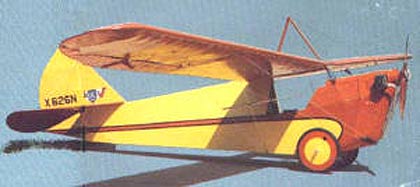
Aeronca C-2 , the "Flying Bathtub"
Floats like a leaf...and about as fast as one too!
The unique distnction of being the first aircraft to be refueled by an automobile also belongs to the C-2. A can of gasoline was handed up to the pilot from a speeding car. The pilot hooked the can with a wooden cane. This took place at an air show in California back in 1930.
The C-3 was introduced in 1930 and was a bit more powerful. Many pilots said that it was almost impossible to make a hard landing in either the C-2 or the C-3, for the pilot had the advantage of actually seeing his wheels approach the runway. Production of the C-3 was halted in 1937. According to the somewhat new guidelines set forth by the U.S Government concerning airworthiness, the C-3 just
The C-3 was introduced in 1930 and was a bit more powerful. Many pilots said that it was almost impossible to make a hard landing in either the C-2 or the C-3, for the pilot had the advantage of actually seeing his wheels approach the runway. Production of the C-3 was halted in 1937. According to the somewhat new guidelines set forth by the U.S Government concerning airworthiness, the C-3 just
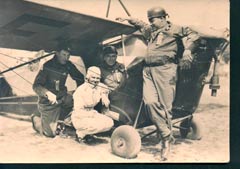
"I just don't think there's room for all of you!"
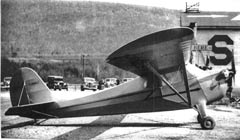
did not make the grade. Some of the construction and lack of gauges contributed to this decision, i.e. external wire braces, extensive fabric construction, single-ignition engine, and lack of an airspeed indicator. Details, details! Who needs an airspeed indicator when the kid on the bike delivering newspapers is moving faster than you are! Just kidding...but not by much! ;-) Owners of the C-2's and 3's were "grandfathered" around the law and were permitted to fly there aircraft.
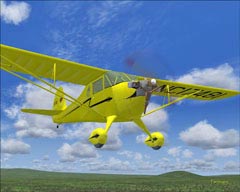
The year 1935 rolled around with the Model L being developed. The Model L had side-by-side seating, and an enclosed cabin, but it has been stated that the true successor to C-2/3 was the Aeronca Model K Scout. This aircraft was introduced in 1937. With the development of the Model K, Aeronca rose to meet modern aviation standards. The "bathtub" look was gone, and a pilot and passenger could sit side by side in this model. 357 Model K's were built.
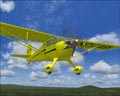
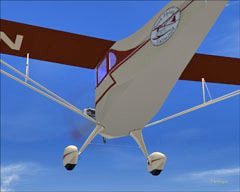
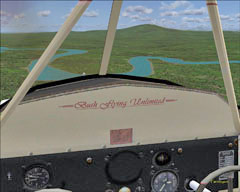
Myers has done a very nice job recreating this historic aircraft. The model features a simple 2D cockpit and a decent Virtual Cockpit as well. An animated pilot that was created by Dave Eckert is also included and moves his head in the direction the aircraft is moving. Opening doors are animated as well as the wheel pants that can be popped on and off by the use of the "O" key (the letter O).
Myers has done a very nice job recreating this historic aircraft. The model features a simple 2D cockpit and a decent Virtual Cockpit as well. An animated pilot that was created by Dave Eckert is also included and moves his head in the direction the aircraft is moving. Opening doors are animated as well as the wheel pants that can be popped on and off by the use of the "O" key (the letter O).
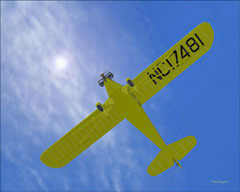
There are three liveries included. The US and Canadian aircraft share the same paint jobs but different markings, and the third is the Bush Flying Unlimited livery. A very nice job has been done on the paint jobs. Textures of the aircraft are also fairly smooth, with good prop textures as well. Installation is explained clearly in the readme file and is a standard, simple install. The readme file also contains some interesting facts about the aircraft itself, as well as some facts about the model. The sounds of the aircraft are that of the default the Wright Flyer. This is not a bad match at all. I visited a site that features Aeronca aircraft (www.aeronca.com), and they had a couple of sound examples on hand to listen to. Myer's has used the default Cub airfile, with slight modifications to compensate for the lower (37 hp) horsepower of the Model K. This is a great model for beginner's to practice with, as the takeoffs and landings are relatively easy. The "K" climbs at a max of 400 fpm and is best flown at or below 5,000 feet. A speed of 70 mph or so is good for cruise. Bring her in for a landing at a bit under 40 mph and you're home free! The tank only holds ten gallons of fuel. At cruise speeds, you'll burn about 4 gallons an hour so no cross country trips in this aircraft unless you plan a whole lot of stops along the way!!!


This has been an extremely fun freeware find! I have been hopping around the Quebec area in this little puppy and it's perfect for the job! For those of you who like the classics and want to enjoy the scenery on your flight adventures, this is an aircraft that is definitely worth a spin! Great job Steven! Another classic for MSFS 2004 made by Steven is the 1938 Ryan SC-W. Probably the topic of another review!
Thanks also to Todd Trainor for the use of some of the pictures from his site, www.aeronca.com!
Thanks also to Todd Trainor for the use of some of the pictures from his site, www.aeronca.com!
A great looking model!
Aeronca Model K